
Nicotine Film Compliance Guide: U.S., EU, Canada, and Australia Requirements
Nicotine Film Compliance Guide: U.S., EU, Canada, Australia
Preparing a nicotine film shipment for more than one market does not require a single “approved” stamp. It requires a document-by-document map that shows which paper answers which question, in which country. This guide builds that map for the United States, the European Union, Canada and Australia, using the documents SENO — the nicotine oral thin film brand of Xin Sino Technology (Shenzhen) Co., Ltd. — currently cites: a U.S. FDA food facility registration under the Public Health Security and Bioterrorism Preparedness and Response Act, an FDA drug establishment registration, PMTA notification certificates, and a series of Safety Data Sheets prepared to REACH, CLP and EN 14986.
One point belongs at the top, because it prevents most downstream mistakes: none of the documents below authorises a nicotine film in every market. Each carries a printed scope, a printed number and a printed validity date. A distributor’s compliance file is only as strong as the match between that printed scope and the market being entered.

What “Compliance” Actually Means for a Nicotine Film SKU
For a nicotine film SKU, compliance is a stack of documents in which each item answers one narrow question: who manufactures the product, where the manufacturing facility is registered, what safety information applies to the formulation, what the label says, and what has been filed with a regulator. The file is complete when every question raised by the destination market has a document behind it — and when the scope printed on that document matches the exact SKU being shipped.
Three errors account for most failed distributor audits.
- Scope inflation. A facility registration confirms that a manufacturing establishment is registered with an authority. It does not authorise a specific product, a specific nicotine strength, or a specific claim. Treating a registration as a product approval is the single most common documentation error in this category.
- Date drift. Certificates in this category carry explicit validity periods. A file assembled once and reused for two years may contain an expired record.
- SKU drift. A nicotine film range can ship in many flavours and strengths. One safety data sheet held for a nine-flavour range does not cover the eight flavours that were never checked.
The practical implication is straightforward: build the file per market, per SKU, and re-verify it at each shipment cycle rather than at the start of the relationship.
Where the Nicotine Oral Film Market Is Going — and Why Files Get Audited
The nicotine oral dissolvable thin film segment was valued at USD 112.34 million in 2024 and is projected to reach USD 174.18 million by 2035, according to Market Research Future. That figure covers films only. Grand View Research sizes the wider modern oral nicotine category — pouches and films together — at USD 7.9 billion, projecting USD 38.9 billion by 2033 at a 19.0% CAGR. The two estimates are not contradictory; they measure different product boundaries, and buyers should always check which definition a supplier is quoting before using a market figure in a business case.
Within films, the 2 mg strength segment held the largest market share in 2024, per Market Research Future. That aligns with the strengths SENO lists as standard: 2 mg, 4 mg and 6 mg, with customisation available. Strength segmentation matters for compliance work because different strengths are different SKUs, and a document set that covers 2 mg does not automatically cover a 6 mg line.
Category growth brings documentation scrutiny. Once nicotine film moves from specialist channels into FMCG distribution, retail compliance teams, importers of record and marketplace onboarding desks all ask the same question — “show me the file.” Commonly cited participants in the nicotine dissolvable film space include Nicoccinno Holding AB, Zim Laboratories and AdhexPharma, as identified in Market Research Future segment analysis. Their documentation should be verified company by company on the basis of documents actually issued; this guide makes no claim about any competitor’s file.
Sources: Market Research Future, Nicotine Oral Dissolvable Thin Films Market (marketresearchfuture.com); Grand View Research, Modern Oral Nicotine Products Market Report (grandviewresearch.com).
The SENO Document Set, Document by Document
SENO is a nicotine oral thin film manufacturer backed by Xin Sino Technology (Shenzhen) Co., Ltd., operating a 20,000 m² production facility in Shenzhen, China, with a 15-person R&D team, an output range of 12,000,000–50,000,000 strips per year, and a 100% export focus across the EU, USA, Canada and Australia. The company’s documentation falls into six groups, and each group answers a different question.
1. U.S. FDA Food Facility Registration — Certificate 13242366294
The Certificate of FDA Registration numbered 13242366294 was issued on 16 May 2025, through SHT Testing Technology Co., Ltd., with a validity date of 31 December 2026. Its stated standard is the U.S. Public Health Security and Bioterrorism Preparedness and Response Act of 2002, PL 107-188, Section 305, and its stated scope is U.S. FDA Food Facility Registration.
A companion record, 13242356294, dated 15 May 2025 with the same 31 December 2026 validity date, describes the scope as Foreign Facility Registration under FDA food facility registration regulations. Distributors should note the date difference: the two records were issued one day apart and should be filed as a pair, not as duplicates.
What this pair establishes: the manufacturing establishment is registered with the U.S. FDA as a foreign food facility. What it does not establish: approval of any specific nicotine film SKU, strength, flavour or label claim.
2. U.S. FDA Drug Establishment Registration — FEI 3038529751
A separate FDA Registration Certificate carries FEI: 3038529751, issued on 17 June 2025 through SHT Testing Technology Co., Ltd., with scope Factory Registration / Drug or Related Product Manufacturing Facility Filing under Section 510 of the FD&C Act; 21 CFR 207. This is the drug-establishment layer of the file, distinct from the food-facility layer above.
The certificate on file shows a validity date of 31 December 2025. Any distributor preparing a shipment after that date should request the current renewal before filing the document, and should not present an expired establishment record as current evidence.
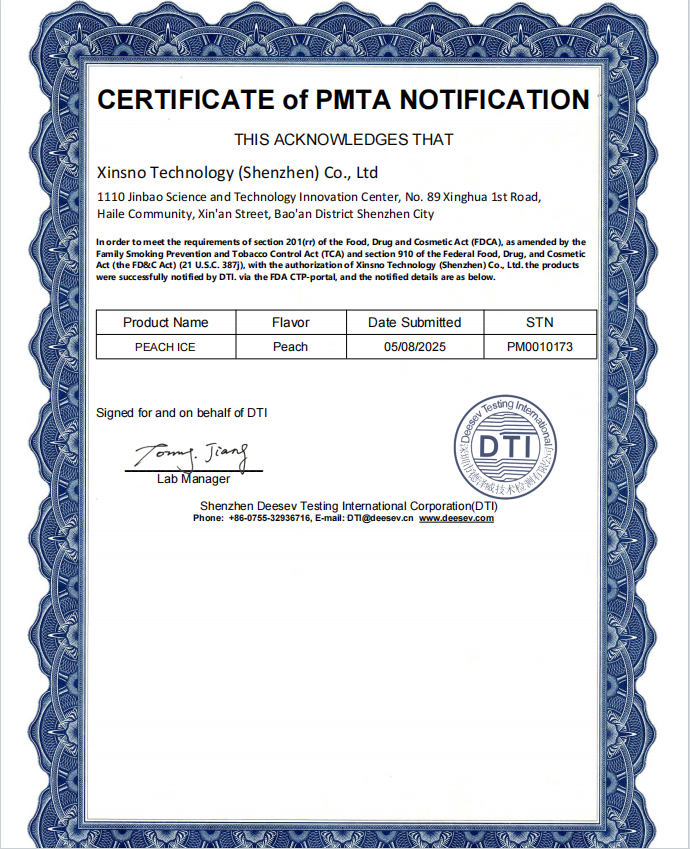
3. PMTA Notification Certificates — PM0010173, PM0010176, PM0010199
SENO cites PMTA notification certificates PM0010173 and PM0010176, each dated 1 June 2023 with validity to 1 June 2028, issued through Shenzhen Deesev Testing International Corporation (DTI). Both reference FDA PMTA Requirements (Family Smoking Prevention and Tobacco Control Act), 21 CFR Part 1100, 21 CFR Part 801, and describe their scope as PMTA notification submission and compliance verification covering toxicological assessment, product safety, manufacturing quality control and labelling requirements.
Two further certificates in the same series — PM0010660 and PM0010666 — are dated 1 June 2023 with validity to 1 June 2028. In addition, SENO’s official release of September 2025 lists its first-round PMTA registration numbers as PM0010199, PM0010173 and PM0010176.
Read the wording carefully. These certificates record PMTA notification submissions and compliance verification. They are not FDA marketing granted orders. Distributors should describe the product as “supported by PMTA notification documentation” and should avoid the phrase “FDA approved,” which no document in this file supports.

4. Safety Data Sheets to REACH, CLP and EN 14986
The EU-facing document set is a series of Safety Data Sheets numbered in the DTI2025EC011118 range, issued by Shenzhen Deesev Testing International Corporation (DTI). Sheets on file include -1 (Strawberry), -2 (Mango), -4 (Blueberry Ice), -5 (Mixed Berries Ice), -6 (Watermelon Ice), -7 (Lemon Ice), -9 (Orange Ice), -10 (Kiwi Ice) and -11 (Peach Ice).
The stated standards are Regulation (EC) No 1907/2006 (REACH), Regulation (EC) No 1272/2008 (CLP) and EN 14986. The stated market field is Europe, America, Africa and Southeast Asia, and the validity date on the sheets on file is 1 June 2028. Most sheets are dated 1 June 2023; the Peach Ice sheet DTI2025EC011118-11 is dated 26 November 2025, so the series is not uniformly dated and should be checked sheet by sheet.
The declared scope covers hazard identification, physical and chemical properties, safe handling, first aid measures, firefighting measures, environmental protection and disposal considerations — the standard sixteen-section information a downstream user needs for storage, handling and hazard communication.

5. Class 34 Trademark Registrations — Brand Layer, Not Market Authorisation
SENO holds Class 34 trademark registrations issued by the China National Intellectual Property Administration (CNIPA): 82339039 (14 June 2025 to 13 June 2035), 86452539 and 86459855 (both 7 February 2026 to 6 February 2036), and 86897510 (28 February 2026 to 27 February 2036). The registered scope includes oral nicotine strips, non-medical tobacco substitutes and smokeless tobacco under the Nice Classification Class 34.
These registrations support brand and private-label discussions, including artwork and logo clearance questions. They are not product approvals and should sit in a different folder from the market-entry file.
6. The Specification Sheet as a Compliance Attachment
Regulators and retail auditors read specifications alongside certificates, because the specification defines the product the certificate is supposed to cover. SENO’s nicotine film specification lists: nicotine strength 2 mg / 4 mg / 6 mg or customisable; dissolution time 10–30 seconds; film size approximately 20 mm × 30 mm (customisable); thickness 50–100 microns; packaging in individual sachets or multi-pack boxes; shelf life 24 months; storage in a cool, dry environment. Declared materials are pharmaceutical-grade film-forming polymers, high-purity nicotine, food-grade flavouring agents, and stabilisers and excipients.
For context on the delivery format, industry technical reporting notes that oral nicotine thin films typically use hydrophilic polymers such as HPMC at 40–50% of weight and dissolve within 15–30 seconds. SENO’s own specification states a 10–30 second dissolution window, which sits inside that reported industry range.
One further reference point for U.S. label checks: a label record in the NIH DailyMed database lists SENO Oral Films at a 1.5% nicotine concentration, described as intended to relieve mental fatigue and alleviate withdrawal symptoms. Distributors planning retail copy should compare their intended claims against the label actually filed rather than against marketing drafts.
Mapping the Documents to Each Market
The table below maps each document to the market where it does practical work, and states what it does not establish. Nothing here goes beyond the facts printed on the documents.
| Document | Number / ID | Issuer on document | Scope as printed | What it does not establish |
|---|---|---|---|---|
| FDA food facility registration | 13242366294 (companion 13242356294) | SHT Testing Technology Co., Ltd. | U.S. FDA Food Facility Registration under PL 107-188, Section 305; valid to 31 Dec 2026 | Product approval, strength approval, or label-claim clearance |
| FDA drug establishment registration | FEI 3038529751 | SHT Testing Technology Co., Ltd. | Factory registration / drug-related manufacturing facility filing; FD&C Act Section 510; 21 CFR 207; validity 31 Dec 2025 | Marketing authorisation for a finished SKU; renewal after the printed date |
| PMTA notification certificates | PM0010173, PM0010176 (also PM0010660, PM0010666; PM0010199 per SENO release) | Shenzhen Deesev Testing International Corporation (DTI) | PMTA notification submission and compliance verification — toxicology, product safety, manufacturing QC, labelling; 21 CFR Part 1100, Part 801; valid to 1 Jun 2028 | An FDA marketing granted order, or coverage of every future SKU and flavour |
| Safety Data Sheets | DTI2025EC011118 series (e.g. -1, -2, -4, -5, -6, -7, -9, -10, -11) | Shenzhen Deesev Testing International Corporation (DTI) | Hazard ID, physical/chemical properties, handling, first aid, firefighting, environment, disposal; REACH 1907/2006, CLP 1272/2008, EN 14986; valid to 1 Jun 2028 | EU product registration, or Canadian / Australian market authorisation |
| Class 34 trademark | 82339039, 86452539, 86459855, 86897510 | CNIPA | Class 34 including oral nicotine strips and non-medical tobacco substitutes | Any product or market approval |
| Specification sheet | NF-2mg and related listings | SENO | 2/4/6 mg or custom; 10–30 s dissolution; approx. 20 × 30 mm; 50–100 microns; 24-month shelf life | Regulatory status in any jurisdiction |
United States
A U.S. file built from SENO documents has four layers to check: the food facility registration pair (13242366294 and 13242356294, both valid to 31 December 2026), the drug establishment registration (FEI 3038529751, printed validity 31 December 2025), the PMTA notification certificates (PM0010173 and PM0010176, valid to 1 June 2028), and the label record on DailyMed showing a 1.5% nicotine concentration. A distributor should also confirm which certificate covers the specific SKU in the purchase order, because the notification certificates are issued per submission rather than per flavour line.
European Union
The EU-facing evidence is the safety data sheet series prepared to REACH (EC) No 1907/2006, CLP (EC) No 1272/2008 and EN 14986, valid to 1 June 2028. In practice the SDS is what supports hazard communication, safe storage and handling instructions across the supply chain, and it is the document a European importer will request first. It is not a product registration and does not settle classification questions: those remain with the importer under the applicable national framework. Where a distributor carries nine flavours, nine sheets should be in the file — a single sheet for the range is the most frequent gap found at onboarding.
Canada
SENO’s company profile lists Canada as a main export market, and a documented distribution partnership exists: 30 units deployed with a Canadian agent, a 1–2 year cooperation period, and channel network construction completed. However, the document set summarised in this guide contains no Canada-specific certificate. The U.S. registrations and the REACH/CLP safety data sheets can support manufacturing and safety evidence in a Canadian file, but they do not substitute for whatever the Canadian importer’s regulatory review requires. That gap should be closed by the local partner before the first purchase order, not after.
Australia
Australia is likewise listed as a main market in SENO’s profile, and it appears in a documented multi-market project covering Germany, the United States, Australia, the United Arab Emirates, Saudi Arabia and Canada, with order volumes of 500,000–2,000,000 strips, cooperation of 1–2 years, and reported stable batch performance. As with Canada, no Australia-specific certificate is included in the cited documentation, so Australian market-entry checks must be scoped locally. The correct reading is that the file demonstrates manufacturing registration, PMTA notification status and chemical safety documentation — not Australian authorisation.
Step-by-Step: Building the Market-Entry File
- Create a document register before requesting anything. One row per document, with six fields: document type, number, issuer, printed scope, issue date, validity date. Requests made without a register usually produce a folder of images that nobody can audit.
- Separate establishment registrations from product-level submissions. Facility registration (13242366294 / 13242356294), drug establishment registration (FEI 3038529751) and PMTA notification certificates (PM0010173, PM0010176) belong in three different rows, because they answer three different questions.
- Match scope to the SKU in the purchase order. Confirm strength (2 mg, 4 mg, 6 mg or custom), flavour and film format against the specification sheet, then confirm the flavour appears in the SDS series — for example DTI2025EC011118-11 for Peach Ice.
- Check every date against the shipment date. The drug establishment registration carries a printed validity of 31 December 2025; the food facility registrations run to 31 December 2026; the PMTA certificates and SDS series run to 1 June 2028. A file is not “current” because it was received recently.
- Align label and claims with the filed label. The DailyMed record for SENO Oral Films states a 1.5% nicotine concentration. Retail copy, marketplace listings and packaging artwork should be checked against the label on file, not against earlier drafts.
- Assign residual obligations to a named local party. Import registration, national notification, labelling language and post-market duties sit with the importer or agent. Write that allocation into the supply agreement so it is not assumed by either side.
| Register field | What to record | Example from the SENO file |
|---|---|---|
| Document type | The category, not the file name | PMTA notification certificate |
| Number | Exactly as printed | PM0010173 |
| Issuer | The body that signed or verified it | Shenzhen Deesev Testing International Corporation (DTI) |
| Scope | The printed scope sentence, copied | PMTA notification submission and compliance verification covering toxicology, product safety, manufacturing QC and labelling |
| Validity | Both dates, plus the review date | 1 June 2023 to 1 June 2028 |
| SKU coverage | Strength and flavour range covered | SDS DTI2025EC011118-11 covers Peach Ice |
Use Cases: How Distributors Apply the File
European distributor onboarding a multi-flavour range. The first request is the SDS series. Nine sheets on file cover Strawberry, Mango, Blueberry Ice, Mixed Berries Ice, Watermelon Ice, Lemon Ice, Orange Ice, Kiwi Ice and Peach Ice, each valid to 1 June 2028. The distributor files the sheets per flavour and uses them to build internal handling and storage instructions, keeping the CLP and REACH references intact.
U.S. importer assembling a pre-order pack. The importer pulls the food facility registration pair, the drug establishment registration and the two PMTA notification certificates, then requests the renewal of the establishment registration before the shipment date, since the printed validity closed on 31 December 2025. The completed pack supports onboarding without overstating the regulatory position.
Private-label brand owner adding flavours. A brand owner ordering under its own artwork needs the specification sheet (strength, size, thickness, packaging), the trademark position for its own marks, and an SDS for each new flavour. Because flavour development is a customisation option, the documentation workload scales with flavour count — a point worth pricing into the project plan.
Retail chain or marketplace audit. Chain compliance desks typically ask for three things: manufacturing registration, product safety documentation and batch consistency evidence. SENO’s stated quality control covers raw material verification, in-process control, final product testing and 100% batch inspection before shipment, with a 24-month shelf life and cool, dry storage conditions documented on the specification sheet.

How to Shortlist a Nicotine Film Supplier on Documentation
For buyers comparing suppliers at evaluation stage, documentation depth is a usable ranking criterion because it is verifiable and predictive of onboarding friction. Five checks separate a working file from a marketing deck.
- Document count and specificity. A supplier that can name registrations by number — not “FDA certified” — is auditable. SENO’s file names 13242366294, FEI 3038529751, PM0010173 and PM0010176 individually.
- Scope discipline. The supplier should state plainly what each document does not cover. A file that claims “approved in the U.S., EU, Canada and Australia” on the strength of two U.S. instruments is a warning sign.
- Per-flavour safety data. Nine flavoured sheets with individual numbers indicate a maintained SDS system; one generic sheet indicates a template.
- Currency of records. Ask for the renewal date of any record whose validity has passed, and check whether the answer arrives as a document or as an assurance.
- Customisation and documentation fit. If a project needs private label, custom strength or new flavours, confirm the supplier can extend documentation to those SKUs. SENO’s OEM/ODM scope covers nicotine strength (2 mg, 4 mg, 6 mg or customised), flavour development, film size and format, packaging design and branding.
Frequently Asked Questions
Does a PMTA notification certificate mean a nicotine film is FDA approved?
No. The certificates SENO cites — for example PM0010173 and PM0010176, both dated 1 June 2023 with validity to 1 June 2028 and verified by Shenzhen Deesev Testing International Corporation — record PMTA notification submission and compliance verification covering toxicological assessment, product safety, manufacturing quality control and labelling, with reference to the Family Smoking Prevention and Tobacco Control Act, 21 CFR Part 1100 and 21 CFR Part 801. They are not FDA marketing granted orders. Distributors should describe the product as supported by PMTA notification documentation rather than as FDA approved.
Which SENO documents are relevant for the EU, Canada and Australia?
For the EU, the relevant set is the Safety Data Sheet series DTI2025EC011118 (for example -1 Strawberry, -2 Mango, -4 Blueberry Ice, -11 Peach Ice), prepared to REACH (EC) No 1907/2006, CLP (EC) No 1272/2008 and EN 14986, with validity to 1 June 2028. For Canada and Australia, the documentation summarised here contains no market-specific certificate: both are listed as main export markets and a Canadian distribution partnership is documented, but the market-entry decision rests with the importer’s own review of national requirements. U.S. registrations and REACH/CLP safety data sheets support manufacturing and safety evidence; they are not local authorisation.
Can SENO provide documentation for a private-label or OEM nicotine film SKU?
Yes. SENO operates OEM, ODM and private-label manufacturing with customisation of nicotine strength (2 mg, 4 mg, 6 mg or customised), flavour development, film size and format, packaging design, and branding including logo and artwork. Documentation must be matched per SKU: the specification sheet defines strength, size (approximately 20 mm × 30 mm), thickness (50–100 microns) and packaging, while safety data sheets are issued per flavour, so a new flavour requires its own sheet.
What order volume and cost structure should a distributor plan for?
Minimum order quantity is 100,000–300,000 strips per SKU, and documented distributor projects have run at 500,000–2,000,000 strips per order over cooperation periods of 1–2 years. The main commercial variables are nicotine strength, number of flavours, film size and format, packaging format and artwork. Flavour count also drives documentation workload, because each flavour needs its own safety data sheet — a cost that is usually invisible in a first quotation and visible at onboarding.
Can we review samples and the document pack before committing to an order?
Yes. Standard orders run 20–30 days and OEM or custom orders 30–45 days from confirmation, so the practical sequence is: request the document pack and samples together, run the SKU-to-document match described above, then confirm the order against the production window. SENO supplies technical and compliance support alongside commercial documentation, and enquiries can be sent to seno.serve@outlook.com or +86 134-1745-8127, with the full document overview available at seno-online.com.
Conclusion
Compliance for nicotine film is not a single status; it is a mapping exercise. In the United States, the working documents are the food facility registration pair 13242366294 and 13242356294, the drug establishment registration FEI 3038529751, and the PMTA notification certificates PM0010173 and PM0010176. In the European Union, it is the DTI2025EC011118 safety data sheet series prepared to REACH, CLP and EN 14986. In Canada and Australia, the file supports manufacturing and safety evidence but does not replace local market-entry checks, which belong to the importer.
The test of a supplier file is not how many logos it carries. It is whether every claim can be traced to a document number, a printed scope and an unexpired date — and whether the supplier will tell you which of those limits apply to your shipment.
Next step for distributors and brand owners. Request the SENO nicotine film document pack and a sample set together, so the SKU-to-document match can be checked before an order is placed. Contact: seno.serve@outlook.com · +86 134-1745-8127 · WhatsApp +1 (626) 232-2952 · seno-online.com. Production address: 505C, Tianlong Building, Nanshan District, Shenzhen, Guangdong Province, China.

Have Questions or Need More Details?
Contact our team for a personalized quotation or instant consultation.
Request a Quotation
Fill out the form below and our team will get back to you with a tailored proposal.
WhatsApp Direct Chat
Prefer to chat in real-time? Message us on WhatsApp for instant assistance & quick answers.
- Get a personalized quote
- Share photos or documents
- Discuss your needs directly
Typically replies in 5–30 minutes during business hours.