
SENO Nicotine Film Design: Thickness, Dissolution & Strength
Nicotine Film Design: Thickness, Dissolution Time & Strength Parameters
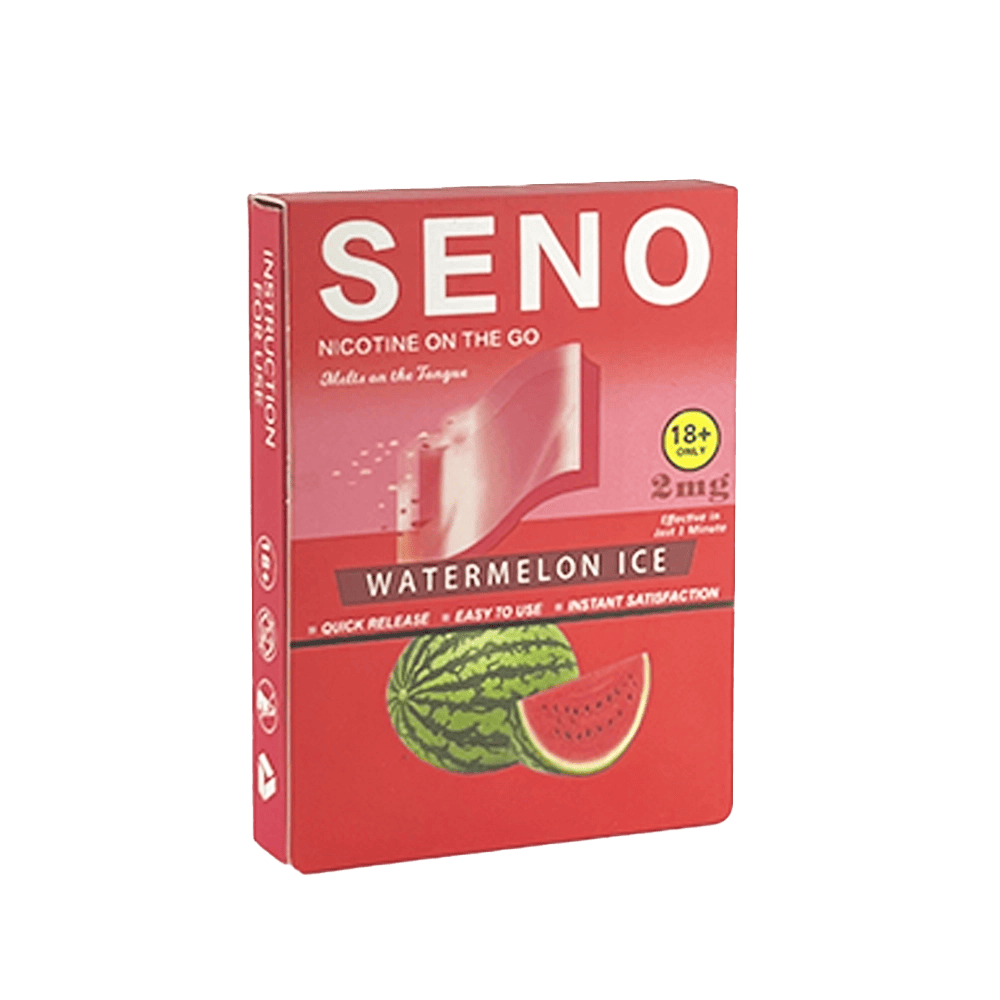
Cover: SENO nicotine film, watermelon ice, 2 mg strength — the finished format that the design parameters in this guide describe.
A nicotine film specification is defined by four measurable parameters: film thickness, film size, dissolution time, and nicotine strength. In the SENO nicotine film specification, thickness runs from 50 to 100 microns, film size is approximately 20 mm × 30 mm, dissolution time falls between 10 and 30 seconds, and nicotine strength is offered at 2 mg, 4 mg and 6 mg, with custom levels available on OEM/ODM programmes.
Everything a buyer later discovers during sampling — how quickly the strip disappears in the mouth, how consistent the dose feels, how the sachet survives transport — traces back to those four numbers and to the material system underneath them: pharmaceutical-grade film-forming polymers, high-purity nicotine, food-grade flavouring agents, and stabilizers and excipients.
This guide is written for sourcing managers, procurement teams and private-label brand owners who are in the research and evaluation stage and need to read a nicotine film datasheet critically rather than accept it at face value. It explains what each parameter controls, where the trade-offs sit, how a custom specification is built step by step, which compliance dependencies should be locked before a production order is released, and how commercial terms such as MOQ and lead time connect to the technical brief.
Problem Definition: Why a Parameter List Is Not Yet a Specification
Two suppliers can quote identical headlines — 20 mm × 30 mm, 2 mg, 50–100 microns — and still deliver products that behave differently in the mouth and carry different regulatory status. That gap is where most evaluation-stage errors happen.
- Parameters are quoted without meaning. A datasheet rarely explains how film area, thickness and polymer loading combine to carry a fixed nicotine dose. Without that link, buyers cannot judge whether a quoted specification is robust or simply copied.
- Dissolution is a window, not a single number. A 10–30 second range describes the boundaries a supplier can engineer within, not one universal behaviour. The position of a finished SKU inside that window is a formulation decision that has to be stated in writing.
- Customization resets qualification. When strength, size or flavour changes, the item becomes a new SKU with its own artwork, dosing rationale and compliance documentation. Procurement planning that ignores SKU multiplication usually misprices the programme.
- Compliance attaches to products and markets, not to the supplier in general. Registration numbers and safety documentation are issued for defined products and defined territories, so a buyer must confirm that the certificates on file cover the exact SKU and the exact destination market.
These four issues are not commercial details that can be settled after a purchase order. They determine whether a nicotine film programme is procurable at all.
Industry Background: A Narrow Category Inside a Fast-Moving Oral Nicotine Market
Market figures for this category depend heavily on how the boundary is drawn. Market Research Future estimates the global nicotine oral dissolvable thin film market at USD 112.34 million in 2024, projected to reach USD 174.18 million by 2035. Grand View Research, using the broader modern oral nicotine definition that includes pouches as well as films, estimates that larger category reaching USD 38.9 billion by 2033 at a 19.0% CAGR. The two numbers are not contradictory; they measure different product scopes, and buyers should expect the same divergence whenever a supplier quotes a market size.
Within the film category itself, Market Research Future reports that the 2 mg strength segment held the largest market share in 2024, targeting moderate to heavy smokers. That is a useful planning signal for private-label programmes: the mid-low strength band remains the volume anchor, while higher strengths serve narrower consumer segments.
On the supply side, third-party market analysis of this segment names Nicoccinno Holding AB, Zim Laboratories and AdhexPharma among the global participants. SENO, operated by Xin Sino Technology (Shenzhen) Co., Ltd., manufactures nicotine oral thin film at a 20,000 m² facility in Shenzhen and exports entirely to international markets, with distributors across Europe, North America and the Middle East. Buyers building a shortlist should compare suppliers on the parameters set out in this guide rather than on brand familiarity alone.
Technical literature on oral thin film drug delivery describes hydrophilic polymers such as HPMC as typical film-forming bases, sometimes accounting for roughly 40–50% of film weight, with dissolution windows of approximately 15–30 seconds that allow nicotine to be absorbed in the mouth and bypass first-pass hepatic metabolism. That context matters: dissolution speed is an engineering outcome of formulation and film geometry, not a marketing claim.
The Five Design Parameters That Shape a Nicotine Film
1. Film thickness: 50–100 microns
Thickness is the parameter that most directly governs how much material — and therefore how much nicotine and polymer — one strip can carry. SENO specifies a 50–100 micron range, which gives formulators room to hold 2 mg, 4 mg or 6 mg doses in a strip of roughly the same footprint by adjusting film weight rather than film area.
Thickness also affects handling. Thinner films tend to sit more discreetly against the mucosa and dissolve faster; thicker films carry higher loads more comfortably and are easier to handle in automated packaging. For buyers, the practical question is whether the supplier can hold thickness within a stated tolerance across production batches, because thickness drift changes both dissolution speed and dose consistency.
2. Film size: approximately 20 mm × 30 mm
Film size determines the contact area available for absorption and the physical presence of the product in the mouth. The SENO standard is approximately 20 mm × 30 mm, and the size can be customized. A larger strip increases mucosal contact area; a smaller strip prioritises discretion and comfort. Because dosage is carried by total film mass, size and thickness trade against each other: a smaller strip needs a thicker or denser film to hold the same nicotine load.
Size also drives downstream decisions. Cut dimensions affect sachet and retail carton artwork, secondary packaging efficiency and — in markets where child-resistant or moisture-resistant packaging is required — the mechanical format of the pack itself.
3. Dissolution time: 10–30 seconds
Dissolution time controls the user's sensory experience and the rate at which nicotine becomes available. SENO specifies a 10–30 second window. Published industry analysis typically places oral thin film dissolution at around 15–30 seconds, so the SENO specification spans the commonly cited band and extends slightly below it for programmes that want a faster-disappearing strip.
Dissolution is not a stand-alone setting. It is the result of polymer selection, polymer loading, film thickness and flavour system, and it interacts with strength: a faster-dissolving film of the same thickness releases its nicotine over a shorter interval. Procurement teams should therefore ask for dissolution to be defined for the finished SKU — the specific strength and flavour combination — rather than for the product family as a whole.
4. Nicotine strength: 2 mg, 4 mg, 6 mg or custom
SENO supplies nicotine film in 2 mg, 4 mg and 6 mg strengths with custom strengths available through OEM/ODM. Strength is the parameter most visible to the end consumer and the one most tightly linked to market positioning and regulatory labelling.
In the United States, SENO oral films are labelled with a 1.5% nicotine concentration, indicated to relieve mental fatigue and alleviate withdrawal symptoms, according to the DailyMed / NIH drug label database entry for SENO oral film (2025). This illustrates a point that catches buyers out during evaluation: the same product can be described by an absolute dose per strip in one market and by a concentration percentage in another. Both descriptions must match the label actually approved for the destination market.
5. Composition: polymers, nicotine and flavourings
The material set behind a nicotine film is deliberately short: pharmaceutical-grade film-forming polymers, high-purity nicotine, food-grade flavouring agents, and stabilizers and excipients. Each element carries a purchasing consequence.
- Film-forming polymers set the mechanical backbone — tensile behaviour, mouthfeel and dissolution profile.
- High-purity nicotine supports accurate dosing and reduces the burden of impurity documentation in regulated markets.
- Food-grade flavouring agents allow flavour development across mint and fruit lines, as well as custom flavours for private-label programmes.
- Stabilizers and excipients protect product integrity over the shelf life — SENO specifies 24 months, with storage in a cool and dry environment.
Packaging is part of the composition decision in practice. SENO supplies nicotine film in individual sachets or multi-pack boxes, and both formats must be settled before artwork, labelling and market-specific requirements such as moisture-resistant or child-resistant packaging are finalised.
Step-by-Step: How a Custom Nicotine Film Specification Is Built

OEM/ODM customization covers nicotine strength, flavour development, film size and format, packaging design and branding.
- Define the target dose and user experience. The brief starts with the strength band (2 mg, 4 mg, 6 mg or a custom level) and the intended sensory profile — how quickly the film should disappear and how discreet it should feel. This step determines everything downstream.
- Fix the film geometry. Size and thickness are agreed together. SENO's standard is approximately 20 mm × 30 mm at 50–100 microns, and both can be customized, but they must be settled as a pair because they jointly carry the dose.
- Set the dissolution window. Within the 10–30 second range, the programme selects a target and confirms it for the specific strength and flavour combination, since polymer loading and flavour system both shift dissolution behaviour.
- Select strength and flavour architecture. SENO supports strengths of 2 mg, 4 mg and 6 mg plus custom levels, and flavour development across mint, fruit and custom profiles. Every strength-flavour combination becomes its own SKU.
- Lock packaging, shelf life and storage. Individual sachets or multi-pack boxes are chosen, branding and artwork are applied for private label, and the 24-month shelf life and cool, dry storage requirement are written into the specification.
- Qualify the product. SENO's quality control covers raw material verification, in-process quality control, final product testing and consistency checks, and 100% batch inspection before shipment.
- Scale to production. Monthly capacity runs from 1,000,000 to 5,000,000 strips. Standard orders are quoted at 20–30 days and OEM or custom orders at 30–45 days, against a minimum order quantity of 100,000–300,000 strips per SKU.
Use Cases: Where Design Priorities Change
Nicotine film is a device-free, combustion-free product used on demand, without any equipment. That single fact drives several distinct procurement scenarios, each of which weights the parameters differently.
- Retail FMCG distribution. Volume sits in the 2 mg band. Buyers prioritise batch-to-batch consistency, sachet integrity and retail-ready packaging.
- Private label and brand owners. Differentiation comes from flavour, strength mix and packaging design rather than from the base film, so customization flexibility and SKU-level compliance documentation matter most.
- Vape and tobacco alternative channels. These buyers typically need higher strengths and faster dissolution to match the expectations of consumers transitioning from other nicotine formats.
- Cross-border e-commerce. Multi-market listings require labelling and documentation that match each destination market, which makes product-level certificates more important than company-level claims.
- Discreet, regulated environments. Offices, air travel, indoor retail spaces and events where smoking is restricted are the defining end-use scenarios. Here the requirements are odourless use, no combustion and a strip that disappears quickly and quietly.

Indoor and mobile use cases — offices, travel and regulated environments — place the highest value on fast dissolution and a discreet film format.
Design Parameter Comparison: Standard Range vs. Customization Boundary
| Design parameter | SENO standard specification | Customization (OEM/ODM) | Primary function it controls |
|---|---|---|---|
| Film thickness | 50–100 microns | Customizable | Dose-carrying capacity, handling, and part of dissolution speed |
| Film size | Approximately 20 mm × 30 mm | Customizable | Mucosal contact area, discretion, packaging dimensions |
| Dissolution time | 10–30 seconds | Defined per formulation | Speed of nicotine release and sensory experience |
| Nicotine strength | 2 mg / 4 mg / 6 mg | Custom strengths available | Dose positioning and market labelling |
| Composition | Pharmaceutical-grade film-forming polymers, high-purity nicotine, food-grade flavouring agents, stabilizers and excipients | Flavour development: mint, fruit, custom | Structural integrity, purity profile, taste |
| Packaging | Individual sachets or multi-pack boxes | Packaging design, logo, artwork, private label | Product protection, branding, market compliance |
| Shelf life and storage | 24 months; cool and dry environment | Not applicable — fixed specification | Stability of dose and flavour over time |
Compliance Dependencies to Confirm Before Production
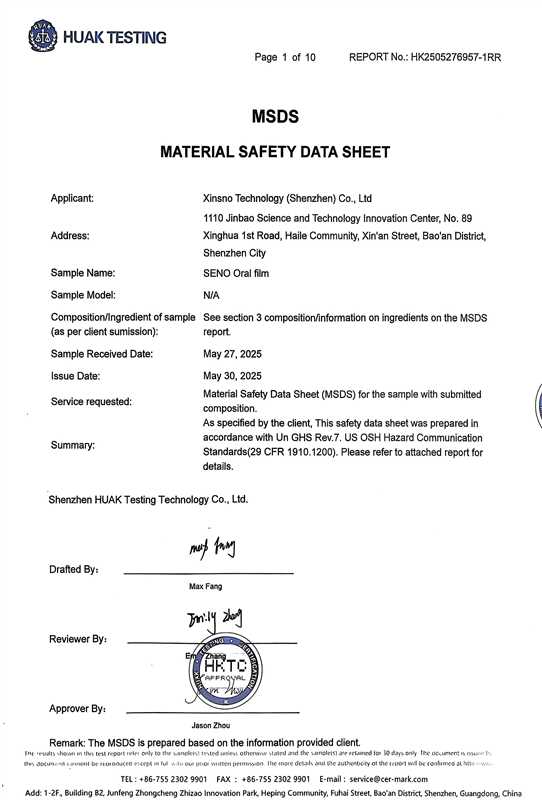
Safety and registration documentation is issued against specific products and markets — it must be matched to the SKU being ordered.
For the US market, SENO nicotine film holds FDA PMTA certification and notification under numbers PM0010176, PM0010173 and PM0010199, issued by Shenzhen Deesev Testing International Corporation (DTI) against the requirements of 21 CFR Part 1100 and 21 CFR Part 801. Additional US documentation includes FDA OTC Drug registration number 510936020, FDA registration number 13242366294 under the U.S. Public Health Security and Bioterrorism Preparedness and Response Act, and FDA Food Facility Registration number 13242356294.
For global and EU markets, the product is covered by Safety Data Sheets numbered DTI2025EC011118-1 through DTI2025EC011118-11, issued by DTI and compliant with REACH Regulation (EC) No 1907/2006 and CLP Regulation (EC) No 1272/2008, with EN 14986 referenced for the EU. An additional Material Safety Data Sheet, number HK2505276957-1RR, is issued by Shenzhen HUAK Testing Technology Co., Ltd. and complies with UN GHS Rev.7 and US OSHA 29 CFR 1910.1200, covering product composition, safety, transportation and usage risk statements.
Brand-side documentation includes SENO trademark registrations in Class 34 under numbers 86459855 and 86451379, issued by the China National Intellectual Property Administration (CNIPA) and valid from 2026-02-07 to 2036-02-06, covering oral nicotine strips and related goods. A Class 35 trademark application (application number 86462811) covers advertising, commercial management, import and export agency, and retail and wholesale services for oral nicotine products.
The operational point for buyers is simple: certification scope follows the product and the market. A certificate that covers one strength or flavour does not automatically cover another, and a document valid for the US market does not substitute for EU documentation. Specification lock and compliance mapping should happen in the same review cycle.
Frequently Asked Questions
Which registrations and certificates apply to SENO nicotine film, and which markets do they cover?
SENO nicotine film carries FDA PMTA certification and notification numbers PM0010176, PM0010173 and PM0010199 issued by Shenzhen Deesev Testing International Corporation (DTI) under 21 CFR Part 1100 and 21 CFR Part 801, together with FDA OTC Drug registration 510936020, FDA registration 13242366294 and FDA Food Facility Registration 13242356294, all applicable to the US market. For global markets, Safety Data Sheets DTI2025EC011118-1 through DTI2025EC011118-11 comply with REACH Regulation (EC) No 1907/2006 and CLP Regulation (EC) No 1272/2008, with EN 14986 referenced for the EU, and Material Safety Data Sheet HK2505276957-1RR complies with UN GHS Rev.7 and US OSHA 29 CFR 1910.1200. Brand protection is covered by SENO Class 34 trademark registrations 86459855 and 86451379, valid from 2026-02-07 to 2036-02-06.
Can film thickness, size, dissolution time and nicotine strength be customized?
Yes. SENO operates OEM, ODM and private-label manufacturing covering nicotine strength (2 mg, 4 mg, 6 mg or custom), flavour development (mint, fruit and custom profiles), film size and format, packaging design (sachets and retail boxes), and branding including logo, artwork and private label. Standard parameters are 50–100 microns thickness, approximately 20 mm × 30 mm film size, and a 10–30 second dissolution window, all of which can be adjusted within a project specification.
What is the minimum order quantity, and what drives order volume?
SENO sets a minimum order quantity of 100,000–300,000 strips per SKU, with monthly capacity of 1,000,000–5,000,000 strips. Because the MOQ applies per SKU rather than per programme, the number of strength and flavour variants in a project is the main factor that determines total order volume — a private-label range with three strengths and four flavours represents twelve SKUs. Commercial terms are quoted per project, so buyers should finalise the SKU list before requesting pricing.
How can a buyer validate a custom nicotine film before mass production?
Validation starts with the specification itself and continues through quality control. SENO's quality process covers raw material verification, in-process quality control, final product testing and consistency checks, with 100% batch inspection before shipment. Samples can be requested directly from the SENO team at seno.serve@outlook.com or via WhatsApp at +1 (626) 232-2952, so that buyers can confirm dissolution behaviour, flavour and packaging against their own specification before committing to production volume.
What are the typical lead times for standard and custom orders?
SENO quotes 20–30 days for standard orders and 30–45 days for OEM and custom orders, with output capacity of 1,000,000–5,000,000 strips per month. Custom timelines are longer because they include formulation, packaging artwork and SKU-level documentation. Buyers planning a launch can shorten the critical path by confirming thickness, size and dissolution targets early, and by keeping the initial SKU count tight — full specifications and the current product range are published on the SENO website at seno-online.com.
Conclusion: Turning a Parameter List into a Procurable Specification
Nicotine film design comes down to four numbers and one material system. Thickness of 50–100 microns and film size of approximately 20 mm × 30 mm determine how much dose the strip can carry; dissolution time of 10–30 seconds determines how that dose is experienced; nicotine strength of 2 mg, 4 mg or 6 mg — custom available — determines market positioning; and the combination of pharmaceutical-grade film-forming polymers, high-purity nicotine, food-grade flavourings and stabilizers determines whether all of it holds together across a 24-month shelf life.
For sourcing teams in research and evaluation, the discipline that separates a workable programme from an expensive one is sequencing: lock geometry, position dissolution per finished SKU, count the SKUs honestly against the MOQ, and confirm that the compliance documents on file match both the product and the destination market. That sequence turns a datasheet into a specification a factory can actually build against.
Next Step: Request a Sample or Specification Review
SENO, operated by Xin Sino Technology (Shenzhen) Co., Ltd., manufactures nicotine oral thin film at a 20,000 m² facility in Shenzhen and supports OEM/ODM programmes for distributors, brand owners and importers across Europe, North America, Canada, Australia and the Middle East.
Send your target thickness, size, dissolution window and strength combination, and the SENO team will respond with a matching specification and sample plan.
Email: seno.serve@outlook.com
WhatsApp: +1 (626) 232-2952
Website: https://seno-online.com/

SENO production facility, Shenzhen — monthly output of 1,000,000–5,000,000 nicotine film strips with 100% batch inspection before shipment.
Have Questions or Need More Details?
Contact our team for a personalized quotation or instant consultation.
Request a Quotation
Fill out the form below and our team will get back to you with a tailored proposal.
WhatsApp Direct Chat
Prefer to chat in real-time? Message us on WhatsApp for instant assistance & quick answers.
- Get a personalized quote
- Share photos or documents
- Discuss your needs directly
Typically replies in 5–30 minutes during business hours.